
DataRead and explore
Relationships
Discover How to Access Related Data Across Linked Tables
Open a Table
Section titled “Open a Table”-
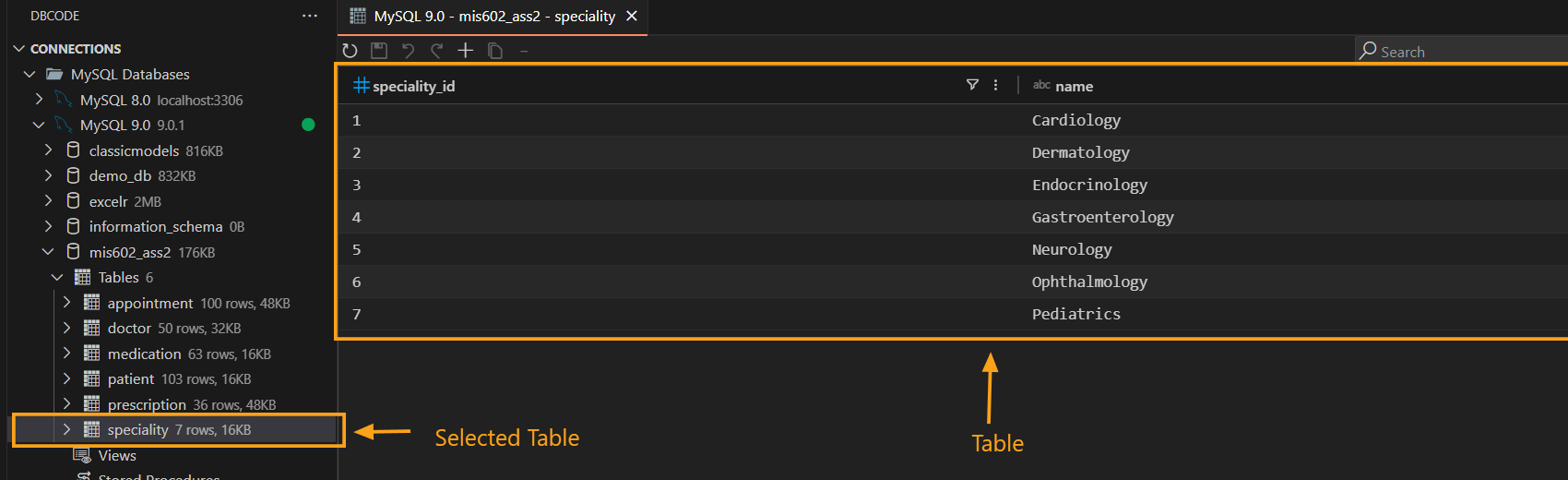
Begin by selecting a database connection from the DB Explorer.
-
Choose the desired database, then select a table by clicking it.
Identify Linked Relationships
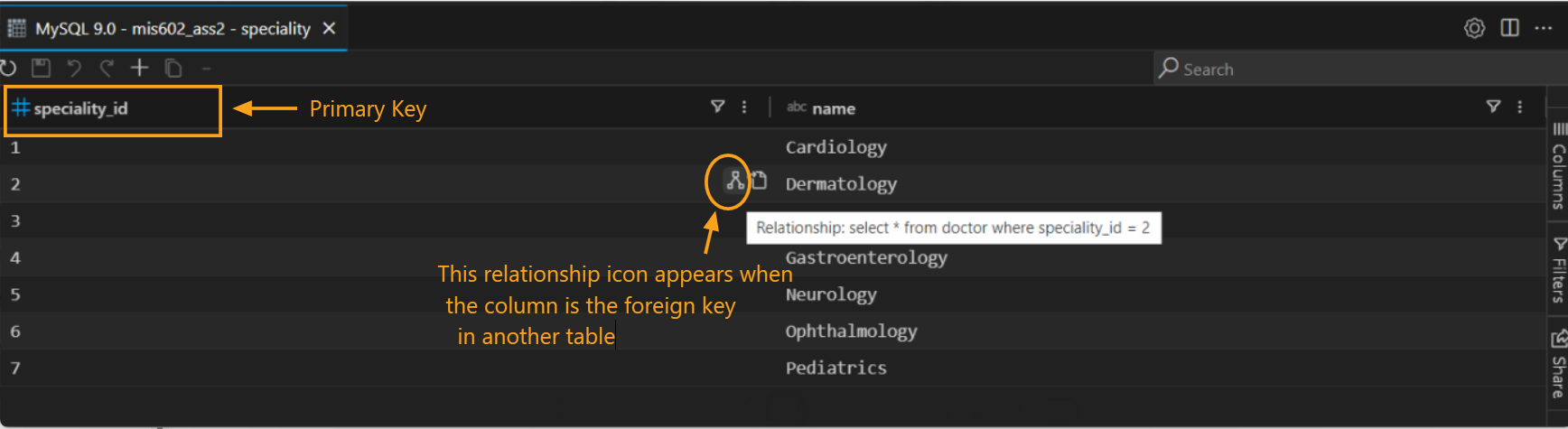
Section titled “Identify Linked Relationships”To understand the relationships between tables, hover over a cell containing a Primary Key or Foreign Key. A small relationship icon will appear beside the cell, indicating that the column is linked to another table.
Browsing Foreign Key Relationships
Section titled “Browsing Foreign Key Relationships”Foreign key relationships allow you to navigate data across multiple tables in both directions:
-
From Foreign Key to Primary Key: When you click on the relationship icon next to a foreign key, you can view the related records in the primary key table. For example, clicking on a
CustomerIDin anOrderstable will show you all orders related to that specific customer in theCustomerstable. -
From Primary Key to Foreign Key: Conversely, while in the related table (e.g.,
Customers), you can explore how many orders each customer has by following the foreign key back to theOrderstable.
View Filtered Related Data
Section titled “View Filtered Related Data”To see the linked data:
-
Hover over the relationship icon to view the message displaying the filtering query for the related table.
-
Click the relationship icon to instantly filter and display data from the related table, as shown below.
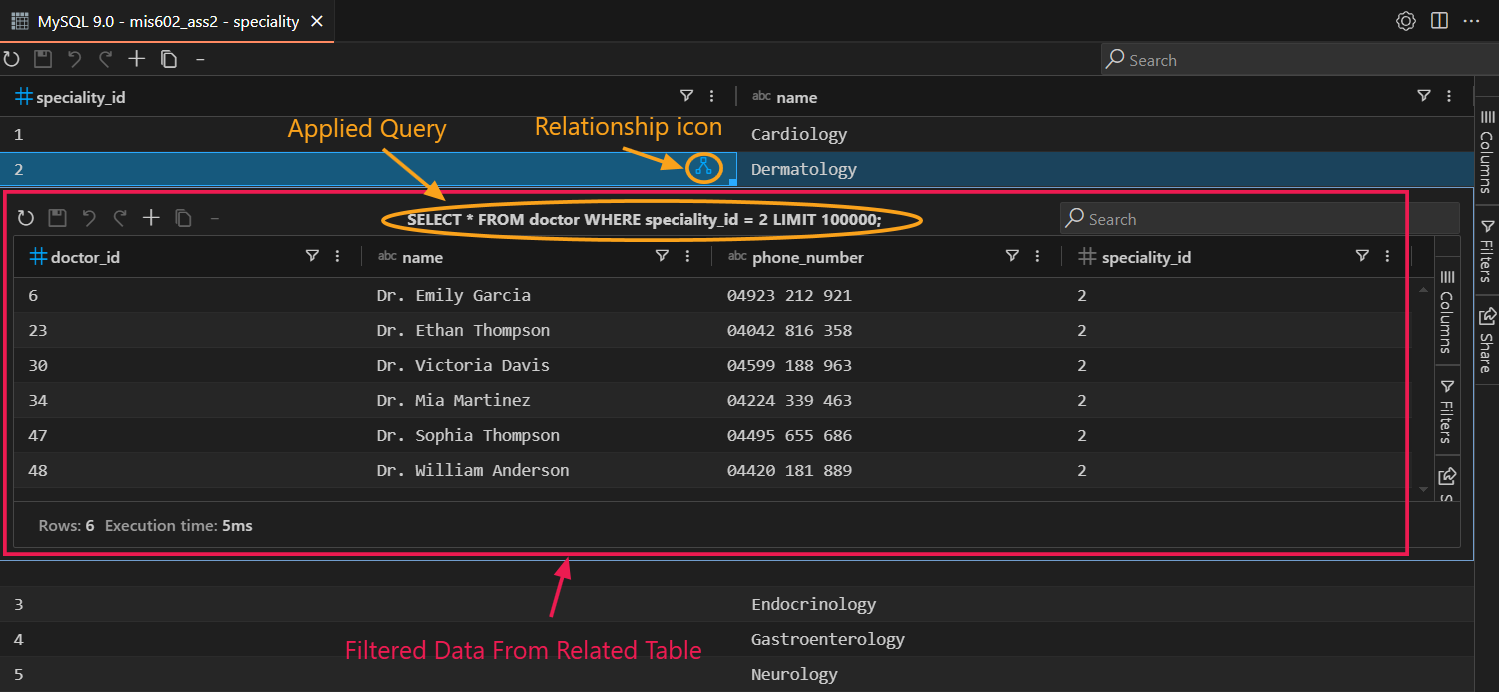
This two-way navigation of foreign key relationships enhances your ability to analyze data comprehensively, allowing for deeper insights and better data integrity.
Inferred Relationships
Section titled “Inferred Relationships”Some databases like MongoDB, DynamoDB, Cassandra, and others don’t have native foreign key support. DBCode can automatically detect relationships based on column naming conventions, enabling the same relationship browsing experience.
How It Works
Section titled “How It Works”Inferred relationships use pattern matching to detect columns that reference other tables. For example:
- A column named
user_idin anorderstable likely references theidcolumn in auserstable - A column named
customerIdreferencesidin acustomerstable
Configuring Inferred Relationships
Section titled “Configuring Inferred Relationships”You can configure inferred relationship patterns in two ways:
1. Connection Settings
Section titled “1. Connection Settings”- Open your connection settings (right-click connection → Edit Connection)
- Navigate to the Inferred Relationships section
- Enable the patterns you want to use:
- Suffix patterns: Match columns ending with
_id,Id,_fk, etc. - Custom patterns: Define your own regex patterns for specific naming conventions
- Suffix patterns: Match columns ending with
- Set the Target column (default:
id) - the column name to reference in target tables
2. Entity Relationship Diagram (ERD)
Section titled “2. Entity Relationship Diagram (ERD)”For visual configuration:
- Open the ERD diagram for your database (right-click tables → Open Diagram)
- Click the Inferred Relationships tool in the toolbar
- Toggle patterns on/off and see relationships update in real-time
- Click Save to persist your configuration to the connection
Predefined Patterns
Section titled “Predefined Patterns”DBCode includes several predefined patterns:
| Pattern | Description | Example |
|---|---|---|
column_id → column.id | Underscore suffix | user_id → users.id |
columnId → column.id | CamelCase suffix | userId → users.id |
column_fk → column.id | Foreign key suffix | user_fk → users.id |
fk_column → column.id | Foreign key prefix | fk_user → users.id |
Custom Patterns
Section titled “Custom Patterns”For databases with unique naming conventions, you can create custom regex patterns:
- Column Pattern: Regex to match the source column name (use capture group for table name)
- Table Pattern: Template for the target table name (use
$1for captured group) - Target Column: The column to reference in the target table
Example: To match ref_users_key → users.pk:
- Column Pattern:
ref_(.+)_key - Table Pattern:
$1 - Target Column:
pk
Explicit Mappings
Section titled “Explicit Mappings”For relationships that don’t follow any naming pattern, you can define explicit column-to-column mappings. This is useful when:
- Column names don’t match any pattern (e.g.,
creator→users.id) - You want to override pattern-detected relationships
To add an explicit mapping:
- In Connection Settings or ERD tool panel, find the Explicit Mappings section
- Click Add Mapping
- Enter the source and target in the format
table.columnorschema.table.column:- From: The source column (e.g.,
orders.creator) - To: The target column (e.g.,
users.id)
- From: The source column (e.g.,
Examples:
| From | To | Description |
|---|---|---|
orders.creator | users.id | Non-standard column name |
logs.entity_ref | products._id | Generic reference column |
audit.modified_by | auth.users.id | Cross-schema relationship |
MongoDB Example
Section titled “MongoDB Example”For MongoDB collections with document references:
// orders collection{  _id: ObjectId("..."),  user_id: ObjectId("..."),  // References users._id  items: [...]}
// users collection{  _id: ObjectId("..."),  name: "John"}
Configure an inferred relationship pattern:
- Enable the
column_id→column.idpattern - Set Target column to
_id(MongoDB’s default primary key)
Now when viewing orders, you’ll see the relationship icon on user_id cells, allowing you to browse to the related user document.
Sharing Relationships via Git
Section titled “Sharing Relationships via Git”Inferred relationships are stored on the connection, so you can version-control them by storing the connection in your workspace:
- Open the connection (right-click the connection and choose Edit Connection).
- Enable Store in Workspace. DBCode saves the connection, including its inferred relationship patterns, to
.vscode/settings.json(or the.code-workspacefile). - Commit that file. Teammates who open the repo get the same relationships in their entity relationship diagram.
Generating Relationships with an AI Agent
Section titled “Generating Relationships with an AI Agent”If you use an MCP-capable agent (Claude, Copilot Chat, Cursor) with the DBCode MCP server, it can work out the relationships for you and write them back:
dbcode-get-tableslets the agent inspect your schema, or it can read your dbt models.dbcode-set-inferred-relationshipswrites the patterns into the connection. With Store in Workspace enabled they land in.vscode/settings.jsonautomatically.dbcode-get-inferred-relationshipsreturns the patterns already configured, so the agent can review or extend them.
Pass mode: "merge" (the default) to add to existing patterns, or mode: "replace" to overwrite them. Inferred relationships render with a DBCode Pro subscription.